
Today Criat is launching two products: AVED Early Warning and the Quantitative Credit Report.
Credit teams already have ratings, market prices and analysts. The problem is not a shortage of information; it is acting on it in time. Ratings move late. Spreads move every day, much of it noise. Analysts cover only part of the portfolio, and their reports age.
What Criat adds is an independent credit view on every name in your portfolio, every day — earlier than ratings, steadier than spreads, broader than any analyst team — with the reasons behind every change.
AVED Early Warning: every name in your portfolio
Warning signals are not scarce. Signals you can act on are.
AVED tracks every name in your bond or loan portfolio daily and answers one question: is this name drifting towards sub-investment grade? Each name carries a status — Green · Stable, Amber · Watch or Red · Alert — that changes only when deterioration is real and persistent, not with a day or two of price noise.
When a name turns Amber or Red, AVED attaches a Full diagnosis report the same day, explaining what changed, why, and where the name is likely heading. AVED is delivered through a web application, with daily briefs and monthly summaries by email, and API, data feed or MCP integration on request, so your own systems and AI tools can draw on it directly.

Quantitative Credit Report: company credit diagnosis
Analyst reports cover few names, use different conventions, and are often missing or out of date when you need them. Quantitative data covers the whole market daily, but it arrives as a column of numbers.
The Quantitative Credit Report puts the quantitative view into the format of an analyst report. It can be generated on demand for any covered company, in English or Chinese, for credit approval, loan monitoring, investment decisions and post-investment review. It adds coverage, timeliness and consistency, and reads each company four ways:
- Cross-sectional: market, sector and peers
- Over time: trends and turning points
- Dynamic: responds to macro and markets
- Multi-dimensional: macro, markets and financials
Traceable: every figure comes from a Criat model or third-party data, or is derived from them. Use the report on its own, or alongside agency ratings, sell-side research and in-house reports.

Built on credit science
Both products run on Criat's iRAP credit science platform. Criat grew out of the Credit Research Initiative at the National University of Singapore (NUS). Our Forward Intensity Model produces a daily Probability of Default (PD) and PD-implied Rating (PDiR) for more than 140,000 firms worldwide, calibrated on more than 35 years of data and more than 20,000 default events since 1990. The IMF and the Monetary Authority of Singapore use these models, and FactSet Portfolio Analytics integrates Criat credit metrics.
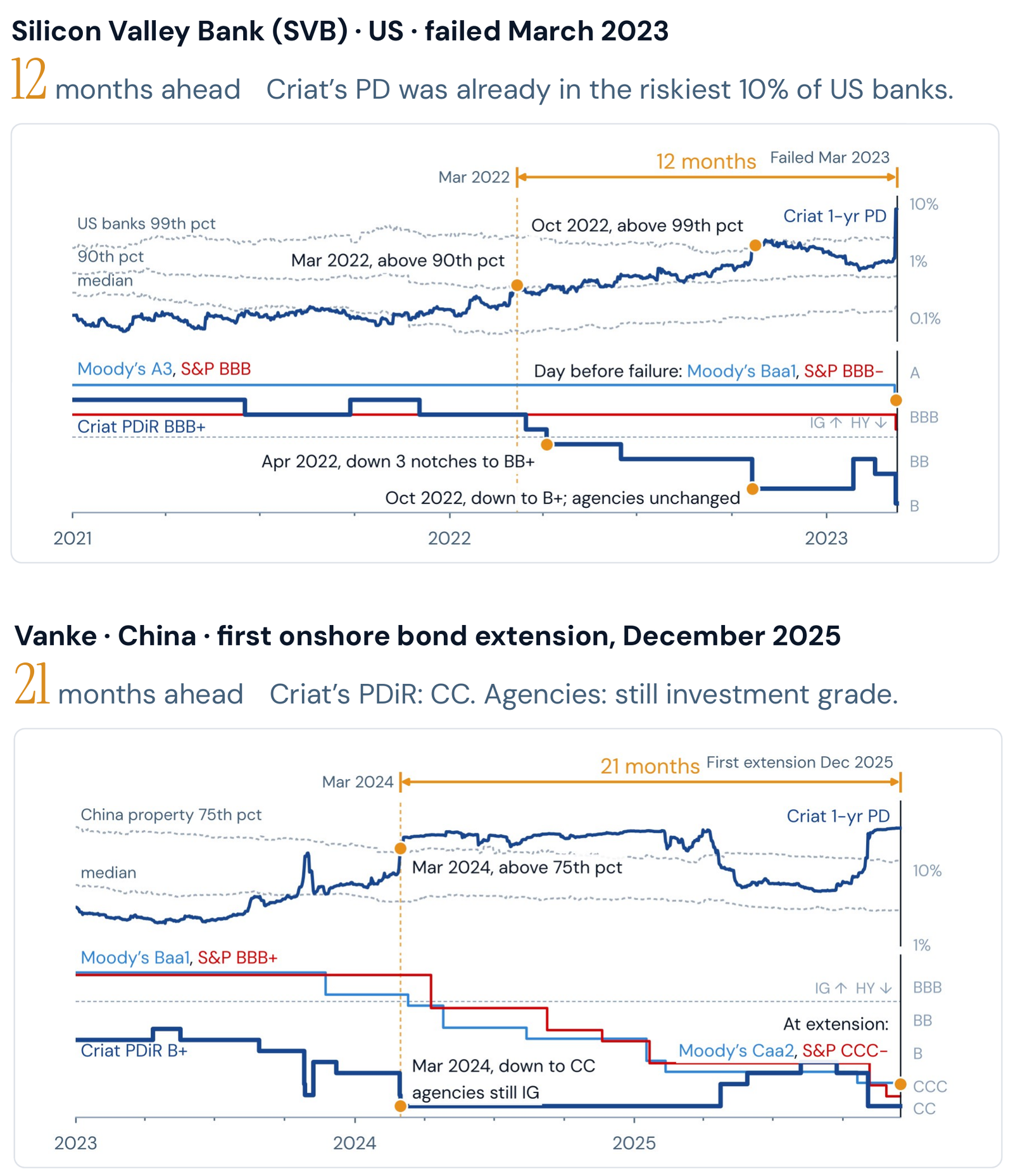
When ratings stand still, risk doesn't:
- Silicon Valley Bank failed in March 2023. Twelve months earlier, Criat's point-in-time PD already placed it among the riskiest 10% of US banks.
- China Vanke, one of China's largest property developers, extended an onshore bond for the first time in December 2025. Twenty-one months earlier, Criat's PDiR had fallen to CC while the agencies still rated it investment grade.
Credit science makes the numbers trustworthy; AI makes them readable the moment you need them.
Don't take our word for it. Test it on your own names.
- A free Quantitative Credit Report: name a company you follow and we'll send you a report within two working days.
- An AVED portfolio review: send us a portfolio list and we'll show you the past two years in AVED, to compare with your own experience (by appointment).
Contact: enquiry@criat.ai, or message Weimin Miao on LinkedIn.
About Criat: Founded in 2017 and headquartered in Singapore, Criat is a spin-off from the Credit Research Initiative at the National University of Singapore. Criat measures credit risk with scientific models and uses AI to bring that analysis into the daily work of financial institutions.