
Agency ratings, sell-side research, in-house reports — and now a fourth kind of credit report.
Analyst reports cover few names and use different conventions. Quantitative data covers the whole market daily, but it arrives as a column of numbers.
The Quantitative Credit Report puts the quantitative view into the format of an analyst report. It can be generated on demand for any covered company, in English or Chinese.
- For
- Investment decisions, credit approval and portfolio monitoring
- How to use
- On its own, or alongside agency ratings, sell-side research and in-house reports
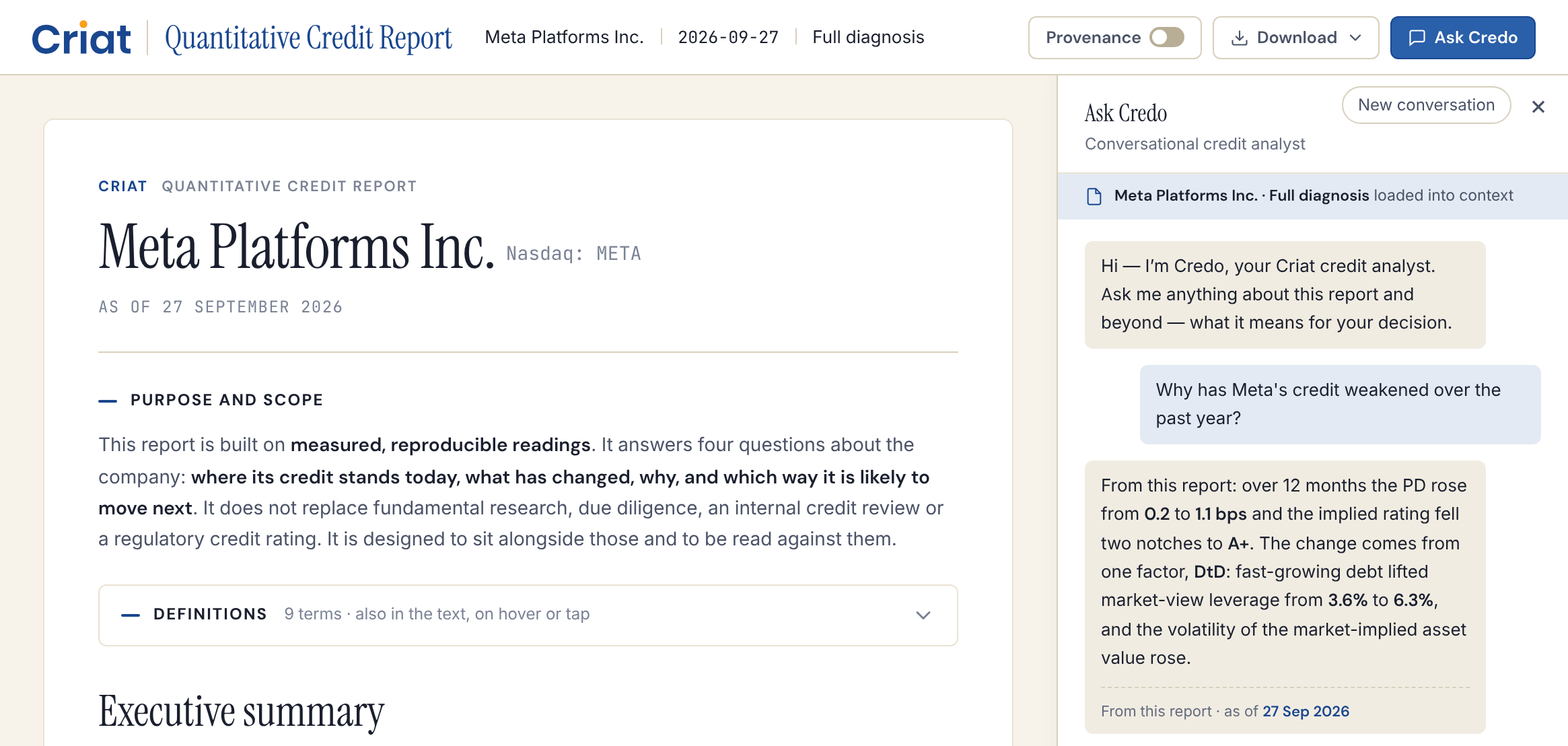
Comparable across peers and over time.
It adds coverage, timeliness and consistency, and reads each company four ways.
- 01Cross-sectionalMarket, sector and peers
- 02Over timeTrends and turning points
- 03DynamicResponds to macro and markets
- 04Multi-dimensionalMacro, markets and financials
- Traceable
- Every figure comes from a Criat model or third-party data, or is derived from them.
- Ask Credo
- Our AI credit analyst has the report in context: ask about anything in it, or the wider picture.
Four questions about every company.
Each answer rests on measured, reproducible readings, so reports are comparable across companies and over time.
- Where does the company's credit stand today?
- What has changed recently?
- Why did it change?
- Which way is it likely to move next?
When ratings stand still, risk doesn't.
The Quantitative Credit Report runs on Criat's iRAP credit science platform, drawing on the daily Probability of Default (PD) and PD-implied Rating (PDiR) from our Forward Intensity Model, which grew out of the Credit Research Initiative at the National University of Singapore (NUS).
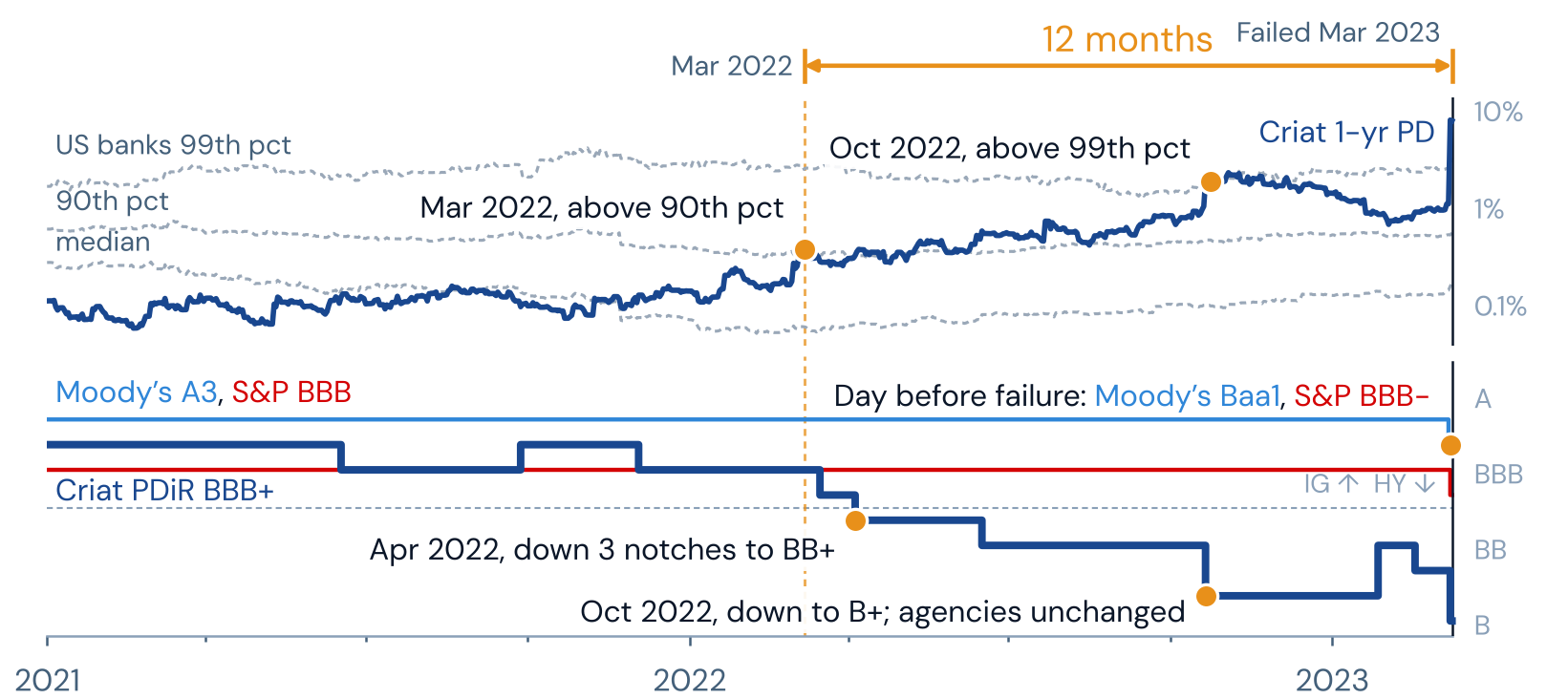
The model, coverage and methodology: Default Prediction12 months ahead, Criat's point-in-time PD already placed it among the riskiest 10% of US banks.
21 months ahead, Criat's PDiR had fallen to CC while the agencies still rated it investment grade.
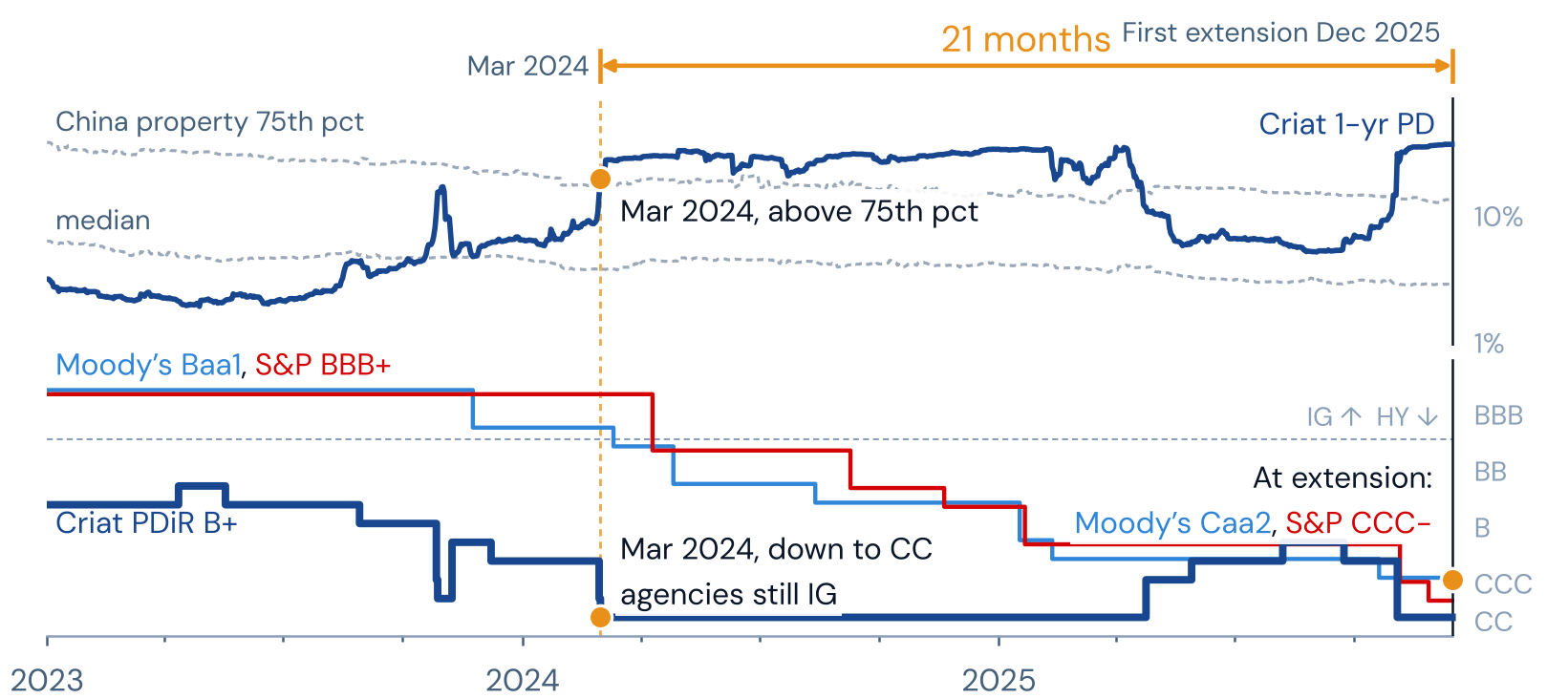
PDiR is a model output, not a credit rating issued by a registered credit rating agency.
Credit science makes the numbers trustworthy; AI makes them readable the moment you need them.
Don't take our word for it. Test it on your own names.
A report on a company you name
Name a company you follow and we'll send you its Quantitative Credit Report within two working days.
Request a reportOr write to us at enquiry@criat.ai