
Dynamic, Forward-Looking
Default Prediction.

Credit risk moves daily — but agency ratings don't. The gap between a firm's actual creditworthiness and its last agency rating can persist for months, leaving portfolios exposed to risk that static scores fail to capture.

Criat Probability of Default (PD) quantifies a firm's default likelihood from 1 month to 5 years; PD-Implied Rating (PDiR) maps it to a letter-grade scale directly comparable to agency ratings — but updated daily.
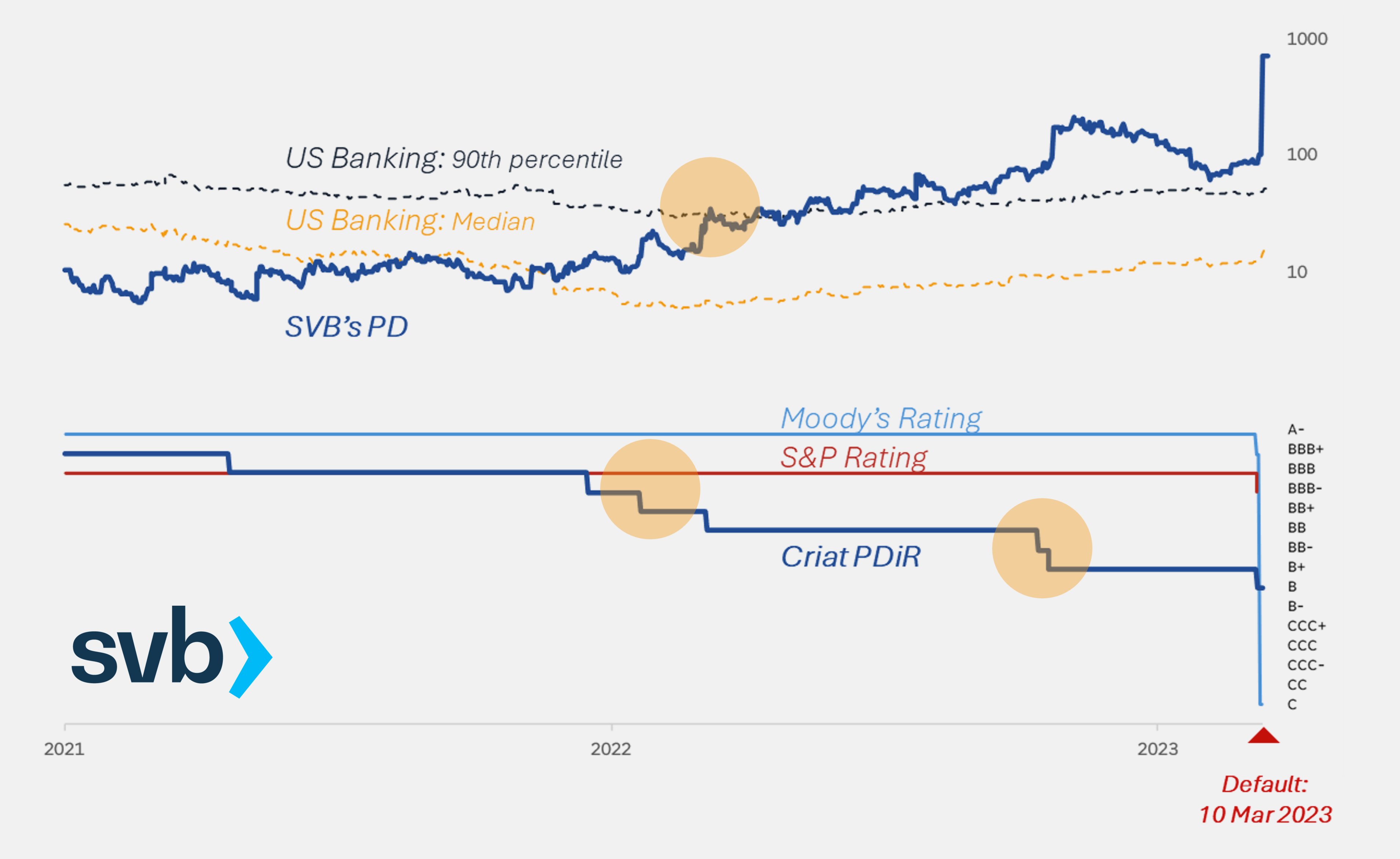
When ratings stand still, risk doesn't.

Silicon Valley Bank — PD-Implied Rating vs. CRA Ratings

Silicon Valley Bankheld investment-grade ratings from both Moody's and S&P until the day it collapsed.

Q1 2022
PDiR drops 3 notches to BB. PD crosses 90th percentile of US banks.
Q4 2022
PDiR deteriorates to B+. Agency ratings unchanged.
10 MAR 2023
SVB defaults. Moody's: A3. S&P: BBB−.
12+
months of early warning — while agency ratings stood unchanged

Every firm, every horizon, every day.

140,000+
Firms Covered
1–60mth
Term Structure
Daily
Update Frequency
35+
Years of History
By Universe
Public Firms94,000+
Private Firms46,000+
Bond Issuers22,000+
Financial Firms25,000+
By Region
Asia Pacific55,000+
North America45,000+
EMEA36,000+
Latin America4,000+

Analyze, integrate, or both.

Criat iRAP — Intelligent Risk Analysis Platform

PD data flows into your existing risk infrastructure — whether you analyze interactively, integrate via feeds, or access natively within partner platforms.

iRAP Web Application
Interactive analysis — PD charts, driving factors, financial analysis, what-if analysis. Global Plus, China, and X editions.
Data Feeds
SFTP, API, or MCP — integrate PD, PDiR, and related metrics into your systems and models.
Partner Platforms
Access Criat data natively within FactSet or Snowflake — embedded in your existing workflow.

The science behind every metric.

Criat's Probability of Default is produced by the Forward Intensity Model (FIM) — a third-generation credit risk model built on econometrics and refined with machine learning.

3rd Generation — 2010s

Forward Intensity Model

Dynamic, forward-looking. Built for all firm types and markets.

1st Gen — 1970sScorecardExpert-driven scoring — foundational and still widely used. Does not respond to macro or market condition changes; reassessed periodically.
2nd Gen — 1980sStructural ModelMerton-based distance-to-default from market value and debt. A significant advance; less effective for Asia & Emerging markets and financial firms.

What makes it different

Forward Intensity Model is a single framework that produces daily, forward-looking default probabilities — across all horizons, firm types, and markets.

01
Hybrid information set — goes beyond any single data source. Default prediction improves when macro conditions, firm fundamentals, and market signals are modeled jointly.
02
Survival-default dependency — a firm's risk at month three depends on how it survived months one and two. Modeling this dependency produces a coherent PD term structure, not isolated point estimates.
03
Granular segmentation — one global model does not fit all. Region-sector calibration with advanced dimension reduction overcomes default scarcity in smaller segments.

How the models are built

Each model draws from up to four risk factor dimensions — macro-financial conditions, firm-specific financial ratios, equity-based factors, and bond-based factors — combined based on data availability and market characteristics.

Public Firm Models

The foundation. 16 risk factors — level and trend used jointly to capture momentum and directional shifts. Calibrated separately by region and sector.

Macro-Financial
Financial Ratios
Equity-Based
Private Firm Models

Extends the Public Firm framework to unlisted companies. Equity-based factors are proxied, producing PD directly comparable to public firms.

Macro-Financial
Financial Ratios
Equity-Based (proxied)
China Bond Issuer Models

Purpose-built for China's onshore and offshore bond markets, where equity data alone is less informative and local macro dynamics diverge from global patterns.

Macro-Financial
Financial Ratios
Equity-Based
Bond-Based
Calibration

Trained on a meticulously curated default database. Default definition aligned with Big 3 rating agencies — covering bankruptcy, missed payments, and distressed exchanges.

20,000+
Default Events
7,600+
Default Firms

Calibrated across North America, Europe, APAC Developed, Emerging Markets, China, and India — separately for Corporate and Financial sectors.

6 regions × 2 sectors
Validation

Criat's in-sample and out-of-sample Accuracy Ratios (AR) are consistent — validating that the model generalizes beyond its training data without overfitting.

CriatStructural model provider
84%
82%
North America
72%
68%
Europe
75%
60%
APAC Developed
75%
60%
Emerging Markets
Data Sources
The Forward Intensity Model (FIM) has been adopted by the IMF, MAS, and AMRO for their public policy work.
IMF
FSAP, GFSR since 2016
AMRO
Annual Consultation Report since 2019
MAS
Financial Stability Review since 2021

See what dynamic PD reveals in your portfolio.

Talk to Our Experts